



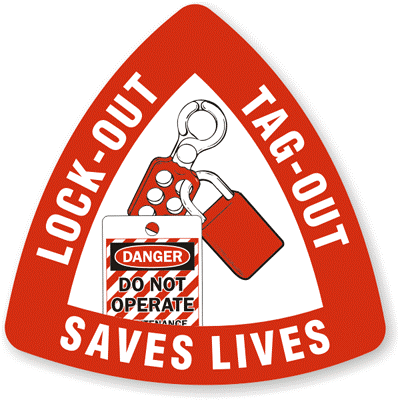
Lockout/Tagout (LOTO) is one of the most critical safety procedures in electrical maintenance. It represents the difference between a safe work environment and a potentially fatal accident. When performed correctly, LOTO protects workers from the unexpected release of hazardous energy—whether electrical, mechanical, hydraulic, or pneumatic.
This article provides a comprehensive, step-by-step guide to LOTO procedures specifically for electrical equipment. Understanding and implementing these procedures can save lives and prevent serious injuries.
Understanding LOTO: What It Is and Why It Matters
Lockout/Tagout (LOTO) refers to specific practices and procedures to safeguard employees from the unexpected energization or startup of machinery and equipment, or the release of hazardous energy during service or maintenance activities.
The concept is simple but powerful:
- Lockout: Physically placing a lock on an energy-isolating device (like a circuit breaker or disconnect switch) to keep it in the safe (off) position. This provides a positive means of control.
- Tagout: Attaching a warning tag to the energy-isolating device, stating “DO NOT OPERATE” and identifying who applied the tag and why.
The Scope of LOTO
LOTO applies to any servicing or maintenance where unexpected energization or the release of stored energy could cause injury. This includes:
- Working on or near exposed electrical parts
- Opening electrical panels for inspection
- Performing repairs on electrically powered equipment
- Conducting preventive maintenance on motors, switchgear, or transformers
In the United States, LOTO is mandated by OSHA Standard 29 CFR 1910.147, while NFPA 70E provides detailed guidelines for electrical safety in the workplace, including specific LOTO principles.
Key Definitions You Need to Know
Understanding the terminology is essential for proper LOTO implementation :
| Term | Definition |
|---|---|
| Authorized Employee | A person who locks out or tags out machines to perform servicing or maintenance |
| Affected Employee | An employee whose job requires operating or using the equipment being serviced |
| Energy Isolating Device | A mechanical device that physically prevents energy transmission (e.g., circuit breaker, disconnect switch, line valve) |
| Energy Source | Any source of electrical, mechanical, hydraulic, pneumatic, chemical, thermal, or other energy |
| Lockout Device | A device (e.g., a key or a combination lock) that holds an energy-isolating device in a safe position |
Important: Push buttons, selector switches, and other control circuit devices are NOT energy-isolating devices and cannot be used as the primary means of isolation.
The 8-Step LOTO Procedure for Electrical Equipment
Industry experts and safety standards outline a standard LOTO process. The following 8-step procedure is based on OSHA and NFPA 70E requirements.
Step 1: Preparation
Before doing anything else, the authorized employee must prepare for the shutdown. This involves:
- Identifying all energy sources feeding the equipment. Refer to single-line diagrams, equipment manuals, or consult with the manufacturer.
- Locating all disconnecting means (circuit breakers, disconnect switches, etc.).
- Reviewing the specific Energy Control Procedure (ECP) for that equipment. A written procedure must be developed and documented for each piece of equipment covered by LOTO.
Step 2: Notification and Shutdown
Proper communication is critical to prevent accidental re-energization :
- Notify all affected employees that servicing is required and that the equipment will be shut down and locked out.
- Provide information on estimated downtime and assure staff they will be notified when the equipment is safe to return to service.
- Shut down the equipment using the normal stopping procedure (stop button, open switch, close valve).
Step 3: Energy Source Isolation
Once powered down, the equipment must be physically isolated from all energy sources :
- Open the circuit breaker or disconnect the switch.
- Remove fuses where applicable.
- Close and lock valves for hydraulic, pneumatic, or steam systems.
- Unplug cords if cord-and-plug-connected equipment is being serviced.
- Block moving parts with mechanical stops.
Critical Rule: Control circuit devices (push buttons, selector switches, interlocks) cannot be used as the sole means for de-energizing circuits. Only devices that provide a physical break in the circuit qualify.
Step 4: Apply Lockout and Tagout Devices
- Attach a lock and tag to each energy-isolating device at every isolation point.
- Each authorized employee working on the equipment must attach their own individual lock and identifying tag.
- The lock physically prevents operation of the disconnecting means. The tag must contain:
- A warning statement prohibiting operation (“DANGER – DO NOT OPERATE”)
- The name of the authorized employee applying the lock
- The date and reason for the lockout
Key Principle: The authorized employee who applies a lock maintains exclusive control of its key.
Step 5: Release or Block Stored Energy
After isolation, equipment can still contain hazardous energy even when disconnected from its primary source. This includes:
- Electrical: Capacitors that hold charge
- Mechanical: Springs, elevated machine members, rotating flywheels
- Pneumatic/Hydraulic: Compressed air or fluid pressure
- Thermal: Heat or steam
Action Required:
- Discharge capacitors and ground high-capacitance elements if necessary.
- Bleed down air, steam, or hydraulic cylinders.
- Block or relieve nonelectrical energy that could re-energize electrical parts.
Step 6: Verification of Isolation
This is the most critical step. Never assume equipment is de-energized. Verify it :
- Operate the equipment controls (e.g., push the start button) to verify it cannot restart.
- Return controls to “off” position after testing.
- Test the circuit parts with properly rated test equipment (multimeter, voltage tester).
For voltage testing, follow the “Prove-Test-Prove” method :
- Prove #1: Verify your test instrument is working properly on a known live source.
- Test: Test the circuit you’re working on. Check phase-to-phase and phase-to-ground.
- Prove #2: Re-verify your test instrument on the known live source to ensure it still works.
For circuits over 600 volts, the test equipment must be checked for proper operation immediately before and after the test.
Step 7: Maintain LOTO During Service
For extended work periods (multiple shifts, multiple days), site-specific procedures ensure continuity of protection :
- Establish clear shift-change procedures.
- Ensure effective communication among all team members.
- Maintain the LOTO status when personnel change.
- Additional authorized employees joining the work must apply their own locks.
Complex LOTO (involving multiple energy sources, crews, locations, or work periods) requires :
- A written plan of action
- A group lockout/tagout device
- Designation of a responsible qualified person in charge
- A method to account for all workers exposed to hazards
Step 8: Bring Equipment Back Online (Restoration)
Before re-energizing, follow this sequence in order :
- Inspect the work area: Ensure all tools, jumpers, grounds, and debris are removed.
- Warn affected employees: Notify all personnel exposed to the re-energization hazard to stay clear.
- Remove LOTO devices: Each lock and tag must be removed by the employee who applied it, or under their direct supervision.
- Visual clearance check: Visually confirm that all employees are clear of the circuits and equipment.
- Restore power and start equipment.
Critical Rule: If the employee who applied a lock is absent, the lock may only be removed by a designated qualified person, and only after ensuring the absent employee is aware that the lock has been removed before they resume work.
When Is Tagout Alone Acceptable?
OSHA and NFPA 70E prioritize lockout over tagout because locks provide a physical barrier. However, there are specific circumstances where tagout is permitted :
- Equipment Not Capable of Being Locked Out: If an energy-isolating device cannot accept a lock, a tagout system may be used.
- Demonstrating Equivalent Safety: If an employer can demonstrate that a tagout program provides a level of safety equivalent to lockout, using additional safety measures.
When using tagout alone, you must supplement with additional safety measures, such as :
- Removing an isolating circuit element
- Blocking a controlling switch
- Opening an extra disconnecting device
Note: For electrical work specifically, most standards strongly prefer lockout whenever physically possible.
Complex vs. Simple LOTO (NFPA 70E-2024)
NFPA 70E-2024 introduced the concepts of simple and complex LOTO :
Simple LOTO
- Involves a single energy source.
- Involves only qualified personnel.
- A written plan may not be required.
- Each qualified person is responsible for their own lock (multi-lock scenario).
Complex LOTO
- Involves multiple energy sources, crews, crafts, locations, disconnecting means, or work periods, OR requires a particular sequence.
- Requires:
- A written plan of action
- A group lockout/tagout device
- One authorized employee in charge
- A method to account for all workers
Employer Responsibilities and Best Practices
Employers must establish and maintain a comprehensive LOTO program :
Program Requirements:
- Written Energy Control Procedures: Documented procedures for each piece of equipment.
- Employee Training: Provide documented LOTO training to all workers exposed to hazards.
- Periodic Inspections: Conduct regular inspections of the LOTO program (at least annually).
- Provide Proper Equipment: Supply LOTO devices (locks, tags, test equipment) and ensure they are unique and identifiable.
Best Practices:
- Use personal LOTO kits for each worker.
- Conduct regular audits of LOTO compliance.
- Implement a permit-to-work system for complex LOTO scenarios.
- Display LOTO procedures and signage at panels.
Common LOTO Mistakes to Avoid
Avoid these frequent errors that compromise safety :
- Shared locks: Each worker must use their own personal lock.
- Failure to verify isolation: “I think it’s dead” is never acceptable.
- Missing or unclear tags: Tags must be signed, dated, and state the reason for isolation.
- Using control devices as isolation points: Push buttons and selector switches don’t count.
- Removing someone else’s lock: Only the person who applied it may remove it.
Conclusion
Lockout/Tagout is a non-negotiable safety requirement for any work on electrical equipment. The 8-step procedure—from preparation to restoration—provides a clear framework for achieving and maintaining an electrically safe work condition.
The bottom line: Never work on electrical equipment without proper LOTO. Your life and the lives of your coworkers depend on it. Implement a robust LOTO program, provide thorough training, and verify every step of the process.